



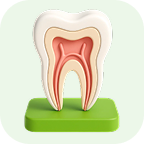
Bone Augmentation
Bone Augmentation: A Gentle and Reliable Path to Implant Placement
Bone augmentation is a procedure that restores the volume of the jawbone when there is not enough bone to ensure stable implant placement. It creates a strong foundation for the future crown and enables long-term, aesthetic, and predictable results.
After a tooth is extracted, bone loss occurs naturally. Within just a few months, the bone begins to shrink, and over 2–3 years, its volume may decrease by 40–60%. Bone augmentation helps replenish this deficit and create safe conditions for implant placement.
When Bone Augmentation Is Needed
- insufficient bone height or width for implant placement,
- bone atrophy after extraction or trauma,
- anatomically thin bone structure,
- defects remaining after implant removal,
- preparation for implant placement or prosthetic treatment.
We always aim to preserve and utilize the patient’s own bone whenever possible. However, when its volume is insufficient, augmentation provides a stable and long-lasting solution for implant placement.
Types of Bone Augmentation
Simultaneous Augmentation
Performed when bone loss is minimal and can be corrected at the same time as implant placement.
- one surgical procedure,
- shorter overall treatment time,
- faster transition to the prosthetic phase.
Staged (Preliminary) Augmentation
Recommended when there is a significant bone deficit. First, new bone volume is created, and the implant is placed afterward.
- a reliable solution even for complex cases,
- restores proper tissue shape and volume,
- stable osseointegration and predictable aesthetics.
Materials Used for Bone Augmentation
- Autologous bone — the patient’s own bone with the highest biocompatibility,
- Allogenic materials — modern bone grafts with excellent predictability,
- Synthetic biomaterials — biocompatible granules that support new bone formation,
- Combined techniques — used for maximum stability and regeneration.
Healing Time
- simultaneous augmentation — 4–6 months,
- staged augmentation — 6–9 months.
Why Bone Augmentation Matters
- provides long-term stability and longevity for the implant,
- restores jaw anatomy and natural gum contours,
- reduces the risk of further atrophy,
- improves both smile aesthetics and chewing function.
Why Patients Choose Omni Dent Clinic
- experienced implantologists and gentle surgical techniques,
- CBCT imaging and precise digital treatment planning,
- certified European biomaterials and strict sterile standards,
- option of treatment under sedation,
- transparent pricing and step-by-step payment plans.
Bone augmentation is a valuable investment in successful implant placement and the long-term health of your smile.
Book a consultation — we will assess your bone condition and create a personalized treatment plan tailored to your needs.
Surgical Treatment
How a Visit Proceeds
Examination and Diagnosis
Anesthesia
Dental Treatment

Completion
A space of health and comfort

Follow us on YouTube
Tým chirurgů a implantologů Omni Dent Clinic

Vitalii Shmadyuk

Václav
Odstrčilík

Boris
Zlenko
Contact Us
FAQ
Is bone augmentation painful?
Bone augmentation is performed under local anesthesia, so you should not feel pain during the procedure. Some mild swelling or discomfort may occur afterward, especially in larger grafting cases, but this is usually manageable with standard pain medication. At Omni Dent Clinic, we use minimally invasive techniques to ensure a comfortable recovery.
How long does it take to heal after bone augmentation?
Healing time depends on the type of augmentation.
-
Simultaneous augmentation (performed with implant placement) typically heals within 4–6 months.
-
Staged augmentation (performed before implant placement) requires 6–9 months for complete maturation.
Your doctor will monitor healing through clinical exams and, if necessary, follow-up CBCT scans.
-
Do I always need bone augmentation before getting a dental implant?
Not always. Many patients have enough bone for immediate implant placement. Bone augmentation is recommended only when the existing bone is too thin or too low to support a stable implant. Modern protocols and precise 3D diagnostics at Omni Dent Clinic help us avoid unnecessary procedures whenever possible.
What materials are used for dental bone augmentation?
We use only certified, medically proven biomaterials, including:
-
autologous bone (your own bone),
-
allogenic bone grafts,
-
synthetic biomaterials,
-
combined grafting techniques for optimal stability.
Your treatment plan will be tailored based on your specific anatomy and clinical needs.
-
How much does dental bone augmentation cost?
The cost depends on the type of augmentation (simultaneous vs. staged), the quantity of graft material required, the surgical technique, and whether additional procedures (such as membrane placement) are needed. After your CBCT examination and consultation, Omni Dent Clinic provides a transparent, itemized treatment plan with an exact cost estimate.